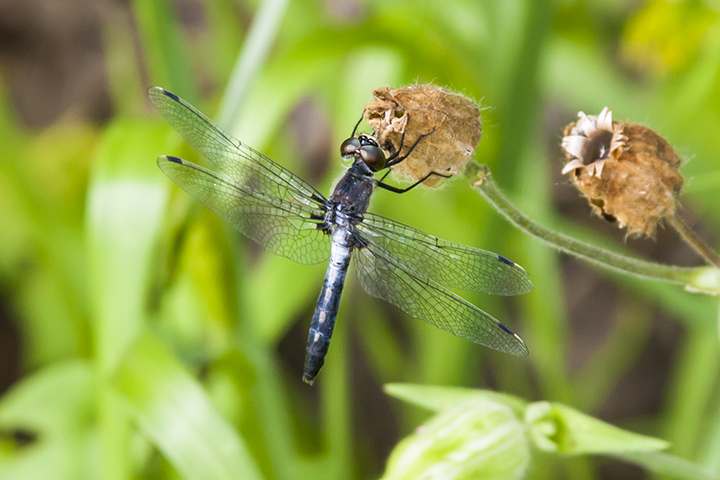
Frosted whiteface (Leucorrhinia frigida)

frosted whiteface

Frosted whiteface (Leucorrhinia frigida) is a small “skimmer” dragonfly. It is fairly common in the upper Midwest, more common in the northeast. It is found from mid-May to mid-August at the edges of boggy or marshy ponds and lakes. It forages by perching on low plants at the waters edge. While the female deposits her eggs her mate will guard her by snatching and holding a rival male until the eggs are laid.

Whitefaces (genus Leucorrhinia) are identified by their white face, small black patch at the base of each wing, and black legs. Frosted whiteface males are distinguished by a brown thorax with no red markings; abdominal segments one through four covered with a whitish, waxy bloom (frosted); and the region of the wing just beyond the forewing triangle having just two rows of cells, not three. Females and juveniles are difficult to distinguish from other whitefaces.

http://minnesotaseasons.com/Insects/frosted_whiteface.html

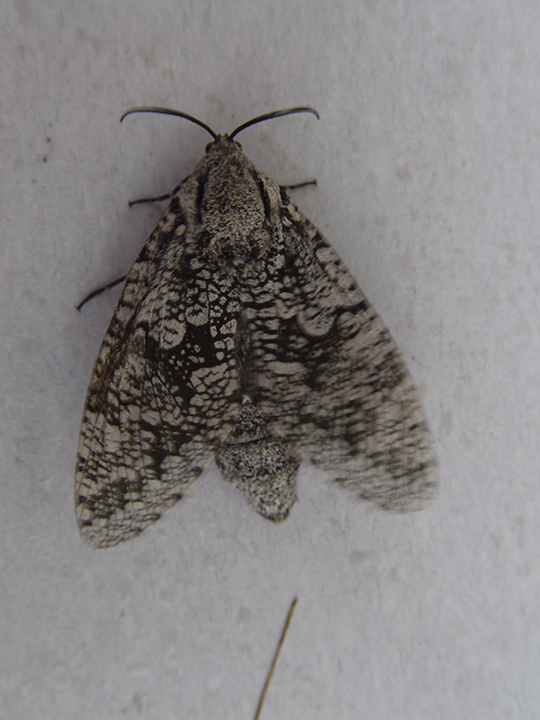
Robin’s carpenterworm (Prionoxystus robiniae), A Very Large Micromoth

Robin’s carpenterworm

Photo by Bill Reynolds

Micromoth is an artificial grouping having no taxonomic equivalent. The name suggests that these are small moths, and indeed most have a wingspans of less than ¾″. However, micromoths are not distinguished by size but by wing venation and the female reproductive tract.

Carpenterworms are wood-boring micromoths. The caterpillars feed by boring into the cambium layer of a tree. This creates galleries and tunnels under the outer bark that decrease the value of the wood and can sometimes kill the tree. Wood has little nutritional value. As a result, the caterpillars take 3 or 4 years to complete their life cycle. They pupate in the spring of their final year and emerge as adults between May and July.

Robin’s carpenterworm (Prionoxystus robiniae) is a medium-sized moth but a very large micromoth. Adults are 11 ⁄16″ to 1¾″ long with a wingspan of 17 ⁄16″ to 3⅜″. They are similar in size and appearance to sphinx moths and are often misidentified as such. They are distinguished by their large size, heavy body, abdomen that extends well beyond the hind wings, light gray wings with a net-like overlay of thin dark lines, accessory cell and 2 complete anal veins on the forewing, 3 anal veins on the hindwing, and yellowish-orange patch on the hindwing of the male.

http://minnesotaseasons.com/Insects/Robins_carpenterworm.html

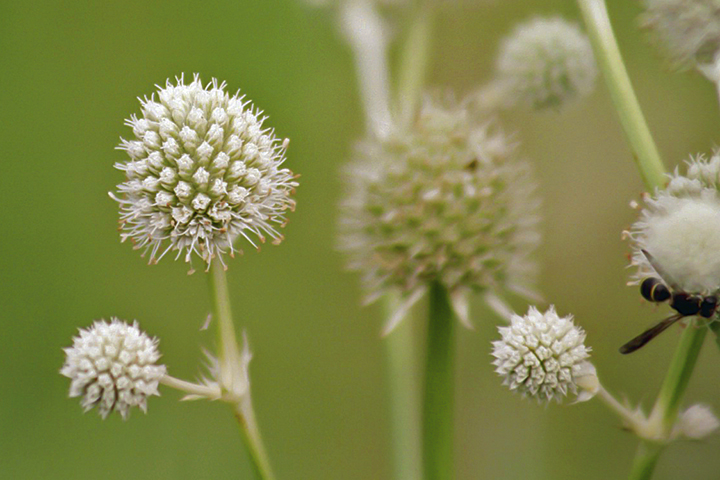
Rattlesnake master (Eryngium yuccifolium var. yuccifolium)

rattlesnake master

Rattlesnake master (Eryngium yuccifolium var. yuccifolium) is a common plant of native tallgrass prairies in the eastern United States. Southeastern Minnesota is the northwest extent of its natural range, but very little tallgrass prairie remains in the state. This habitat loss led the Minnesota DNR to list it as a special concern species in 1984.

The common name is derived from its traditional use by Native Americans to treat rattlesnake bite. The plant was also used as a diuretic, a sedative, a pain reliever, a tonic, and for cordage.

This plant is easily identified. The waxy, bluish-green stem and foliage; stiff, grass-like leaves with widely scattered spiny or thread-like teeth; and white, spherical flower heads, combine to create a unique appearance. There are no similar species in Minnesota.

http://minnesotaseasons.com/Plants/rattlesnake_master.html

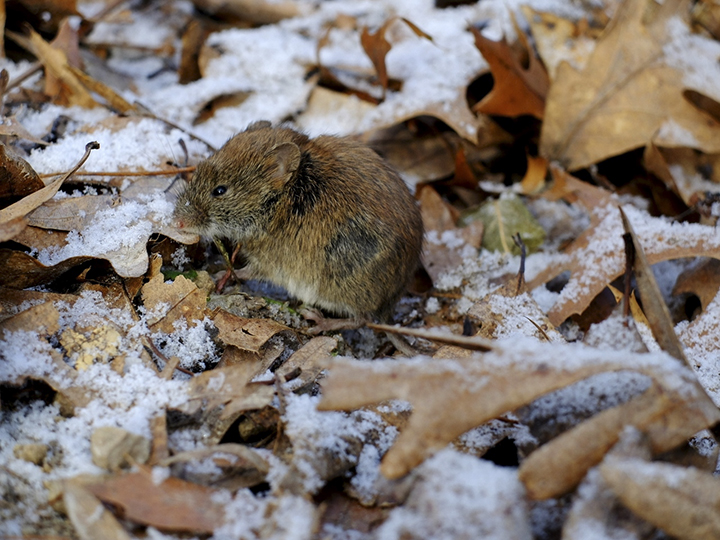
Southern red-backed vole (Myodes gapperi)

southern red-backed vole

Photo by Kirk Nelson

There are six species of voles found in Minnesota. Southern red-backed vole (Myodes gapperi) is one of the smallest. It is common in moist deciduous, coniferous and mixed forests with stumps and logs for ground cover. It is usually the most common rodent in cedar, tamarack, and black spruce swamps. It is active both during the day and at night but more often at night. It is solitary, not forming colonies or pair bonds. It forages mostly on the ground but also in trees. This is the only vole in Minnesota that is a good climber of trees.

Southern red-backed vole is distinguished from mice by a stouter body; shorter, hairy tail; smaller ears and eyes; and molars with high crowns and angular cusps. It is easily distinguished from other voles by the gray sides and reddish back.

http://minnesotaseasons.com/Mammals/southern_red-backed_vole.html

Oak flake gall wasp (Neuroterus floccosus)

oak flake gall wasp

There are over 750 species of gall wasps (Family Cynipidae) in North America. They are all tiny and look pretty much alike. Fortunately, most can be identified by the appearance, location, and host species of the abnormal growths (galls) their larvae produce.

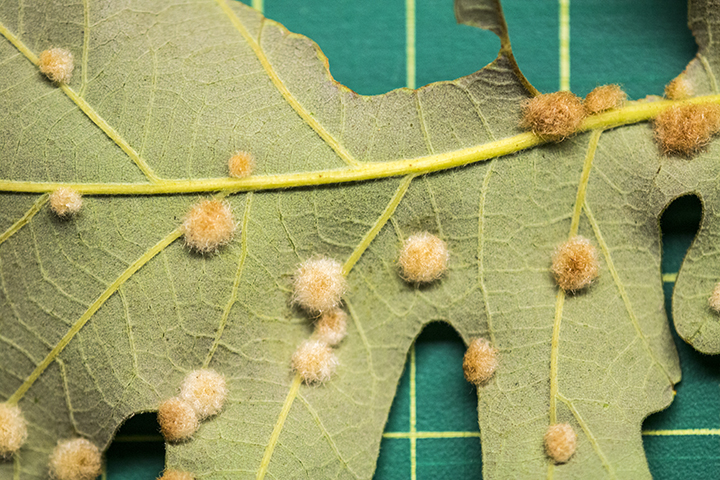
Oak flake gall wasp (Neuroterus floccosus) galls are found on the underside of leaves of bur oak and swamp white oak. They occur singly though there are usually several galls on any one leaf. They are hemispherical, thickly hairy, and ⅛″ to 3 ⁄16″ in diameter including the hairs. The hairs are white at first but soon turn brown. Each gall contains a single chamber and a single wasp larva. It is revealed on the upper leaf surface as a smooth blister-like bump.

http://minnesotaseasons.com/Insects/oak_flake_gall_wasp.html

Pure green augochlora (Augochlora pura)

pure green augochlora

There are more than 2,000 living species of sweat bee (Family Halictidae) worldwide. They are so named because they are attracted to the sweat of humans. Fortunately, they seldom sting and when they do the sting is minor.

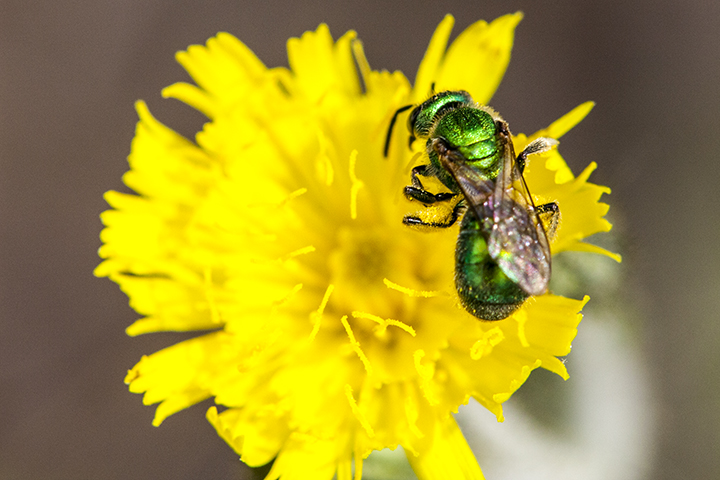
There are four species of Augochlora in the United States, only one of which is found in Minnesota. Pure green augochlora (Augochlora pura) is a moderately-sized, solitary, metallic green sweat bee. It is very common in the eastern half of North America west to Minnesota. It is found from April to October in woodlands and nearby thickets and pastures.

The overwintered mated female emerges in April. Using an existing insect burrow in dead wood as a starting point, she digs a nest consisting of many branched burrows. She places a pollen ball and nectar in each burrow then lays a single egg on the pollen ball. The first generation offspring emerge as adults in June. By the end of June they have constructed their own nests. The larvae or pupa of the last generation overwinter and emerge as adults the following spring. Adult females overwinter beneath rotting logs in a state of diapause. Males die in the fall.

Sweat bees are identified by a short tongue with a short, pointed last segment; single groove below the base of each antenna; lobe at the base of the hindwing longer than the submarginal cell; and basal vein on the wing strongly arched. Pure green augochlora is distinguished by the completely bright metallic green or coppery body; abdomen not conspicuously striped; dark brown, oval-shaped structure at the base of each wing; wing with three submarginal cells, the first longer than the third; marginal cell of the wing squared off at the end; and upper margin of the plate on the upper lip intruded upon by lobes of the plate above it.

http://minnesotaseasons.com/Insects/pure_green_augochlora.html
Four-spotted skimmer (Libellula quadrimaculata)

four-spotted skimmer

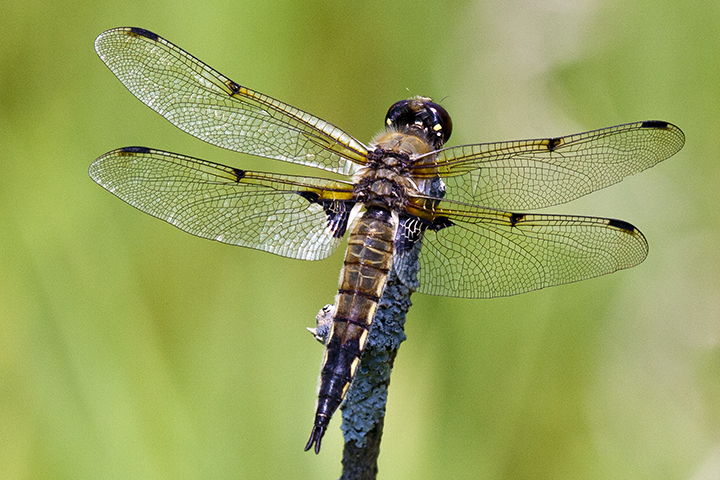
Four-spotted skimmer (Libellula quadrimaculata) is common, widespread, and misnamed.

Eight-spotted skimmer has two large spots on each wing for a total of eight. Twelve-spotted skimmer has three large dark spots on each wing for a total of twelve. Four-spotted skimmer has two small dark spots on each wing and one large spot on each hindwing for a total of ten. A more appropriate name might be ten-spotted skimmer (Libellula decamaculata).

Four-spotted skimmer is an early season, medium-sized skimmer. It is found from mid-May to September at the edges of boggy lakes and ponds, fens, and slow streams. It is usually seen perched at the top of a tall emergent plant or a weed, often far from water.

It is easily identified up close by the two dark spots on the leading edge of each wing. It is further distinguished by the bright yellowish-brown color on the thorax and front half of the abdomen of juveniles, amber streak with yellow veins at the leading edge of each wing on juveniles, black patch at the base of the hindwing, and narrow yellow stripe on each side of the abdomen. Unlike other skimmers, the female abdomen is tapered like the males, not parallel-sided.

http://minnesotaseasons.com/Insects/four-spotted_skimmer.html

Ney Nature Center

Ney Nature Center

Photo by Michelle Isaacson

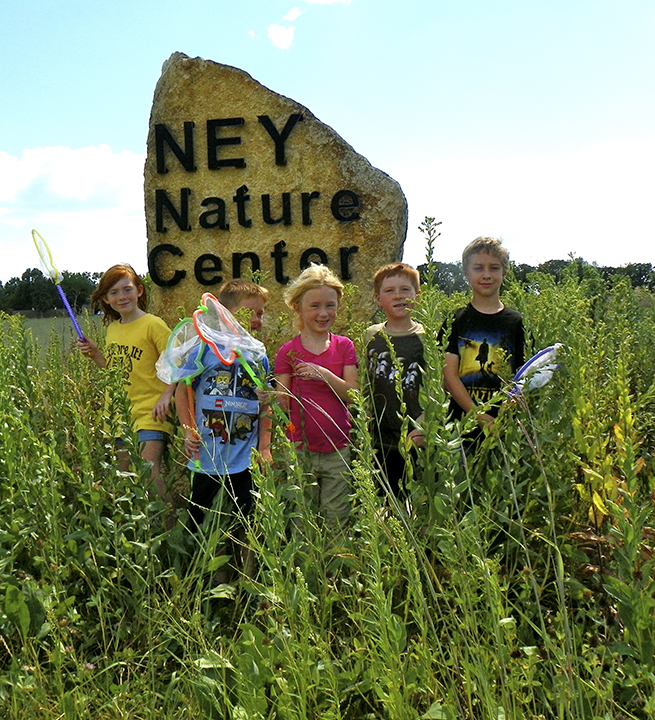
Ney Nature Center is a 446-acre park in Le Sueur County east of Henderson. It is adjacent on the north to Ney Wildlife Management Area and on the south to Henderson Station County Park/River Access. It includes the Minnesota River bluff to the west, the steep ravine of an unnamed, intermittent stream to the south, and prairie to the north.

Ney Nature Center is a hybrid, both a Le Sueur County park, open daily to the public, and a nature center, providing educational events for groups of children. It is one of 70 Minnesota Christmas Bird Count locations. Seventy-two bird species have been sited on bird count days from 1997 to 2014.

http://minnesotaseasons.com/Destinations/Ney_Nature_Center.html

Gray birch (Betula populifolia)

gray birch

Gray birch (Betula populifolia) is native to eastern United States and Canada as far west as Illinois. It has been recorded in Minnesota only twice, once in Anoka County in 2013 and again in Itasca County in 2015. In its native range it is an early successional tree colonizing burned areas, abandoned pastures, road cuts, and other disturbed areas.

Gray birch is one of the smallest trees in the northeast, usually no more than 30′ tall and about 6″ in diameter at breast height. It is short-lived, seldom surviving more than 50 years. The resemblance of the leaves to those of quaking aspen (Populus deltoides) is the source of the species name populifolia.

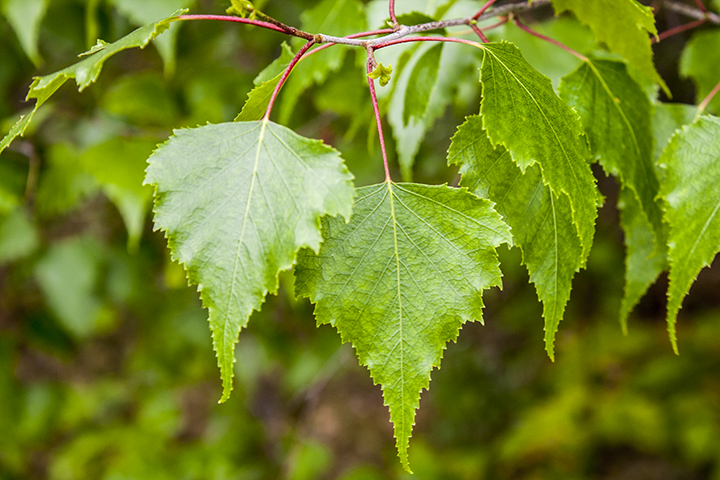
Gray birch is easily identified by the aspen-like triangular leaves with flat bases and long, drawn-out tips. It is also distinguished by grayish-white bark that does not easily peel; dark triangular patches at the base of each branch and branch scar; and male catkins that occur individually, not in groups.

http://minnesotaseasons.com/Plants/gray_birch.html

Phomopsis gall on hickory (Phomopsis spp.)

Phomopsis gall on hickory

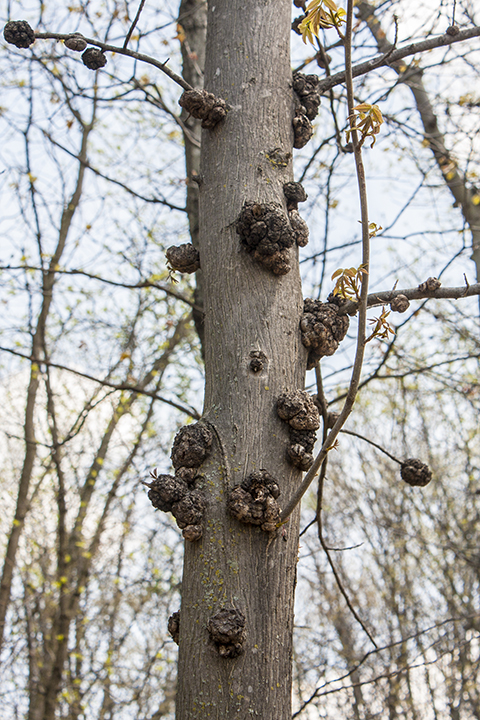
There are at least 232 species of the fungus Phomopsis. Several of these produce bark galls on bitternut hickory. The galls are identical in appearance making identification of the associated species in the field impossible.

Spores are produced throughout the growing season and are spread by wind and rain splashes. It is believed that spores infect a host by entering a wound of a young twig. The fungus then spreads to branches and to the trunk. The galls do not kill the host but reduce vigor and girdle small branches causing dieback. Uninfected trees may occur near heavily infected ones.

Galls may occur singly or in clusters on the trunk and branches. They are woody, rough, more or less round swellings. They appear as tight clusters of nodules. They can be very small to 10″ in diameter. If cut open they reveal disorganized woody tissue but no insect chambers or tunnels.

http://minnesotaseasons.com/Fungi/Phomopsis_gall_on_hickory.html